Signs of economic recovery, but investment still slow ?
NEPSE Labs
May 14, 2026
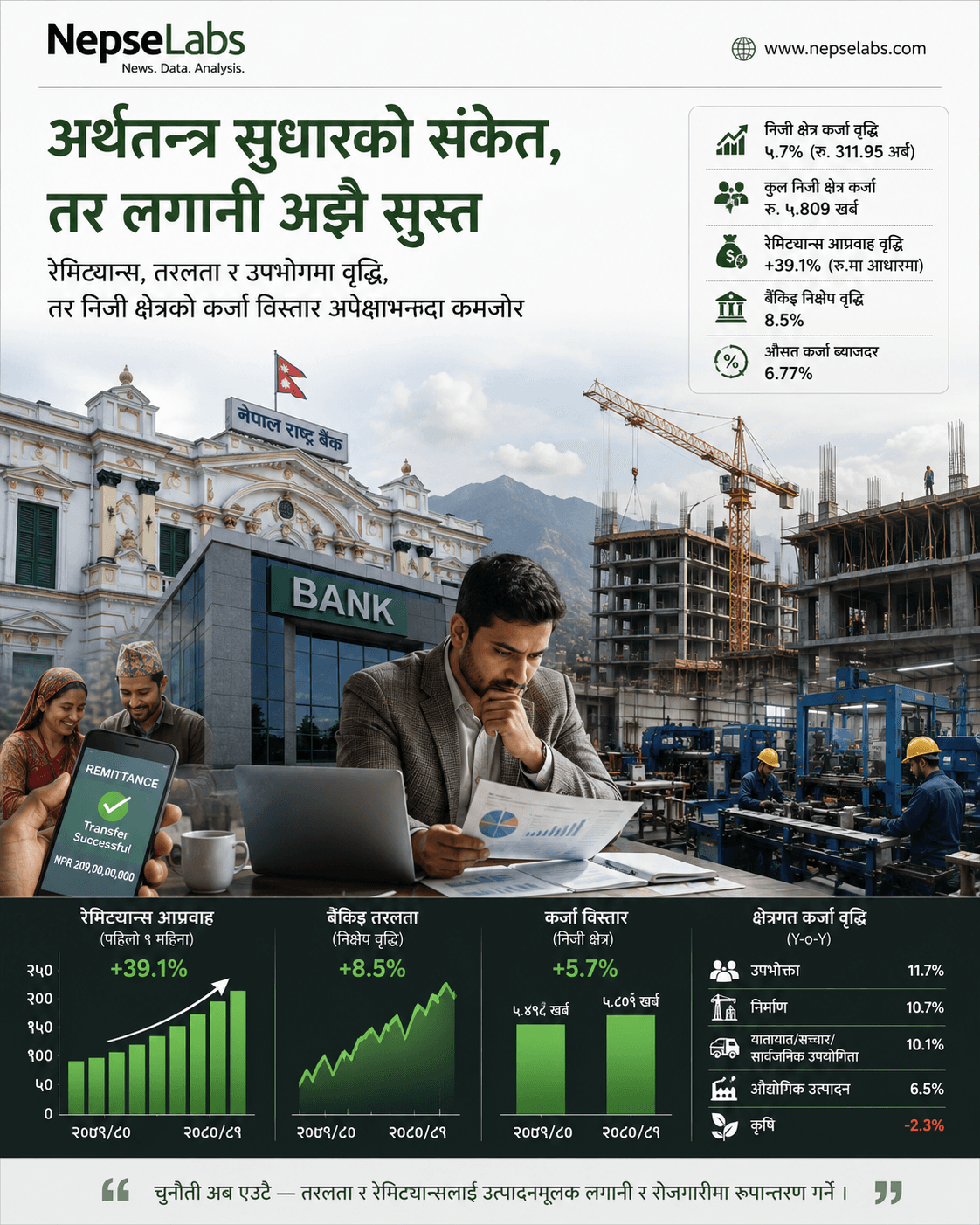
Nepal’s economy appears to be gradually regaining momentum by the third quarter of the current fiscal year, with stronger remittance inflows, rising imports, improved banking liquidity and growing consumer activity signaling a broader economic recovery. However, despite these encouraging macroeconomic indicators, expansion in private sector lending has remained weaker than expected, highlighting continued caution among businesses and investors.
The latest report published by the Nepal Rastra Bank shows that credit flow to the private sector increased by 5.7 percent, or Rs. 311.95 billion, by mid-April of the current fiscal year. Total outstanding private sector credit has now reached Rs. 5.809 trillion. Although lending growth remains positive, it is noticeably slower compared to the same period last year, when private sector credit had expanded by 7.1 percent. On a year-on-year basis, credit growth currently stands at 6.9 percent.
Economists say the figures reveal an economy that is recovering unevenly. While liquidity and consumption are improving, productive investment has not accelerated at the same pace. Businesses continue to remain cautious about expanding operations due to uncertainty regarding future demand, policy stability and long-term market conditions. The data suggests that Nepal’s economic recovery is still being driven more by consumption and remittance inflows than by industrial expansion or private sector confidence.
The banking system, however, appears to be in a much more comfortable position compared to the previous fiscal year. Deposits in banks and financial institutions increased by 8.5 percent during the review period, while annual deposit growth reached 15.5 percent. Excess liquidity in the banking sector has continued to push interest rates downward. According to the central bank, the weighted average interbank interest rate stood at 2.75 percent, while the weighted average yield on 91-day Treasury bills remained at 2.61 percent.
Commercial banks’ weighted average deposit interest rate declined to 3.40 percent, while the average lending rate stood at 6.77 percent. Analysts believe the current interest rate environment is relatively favorable for borrowing. However, the slow expansion of private sector credit indicates that lower borrowing costs alone are not enough to revive investment appetite. Businesses appear more concerned about market risks and weak demand than financing costs.
A closer look at the lending structure also reveals deeper trends within the economy. Around 63.4 percent of total private sector loans are backed by real estate collateral, highlighting Nepal’s continued dependence on property-based financing. Sector-wise, consumer lending recorded the strongest growth at 11.7 percent, followed by construction at 10.7 percent and transportation, communication and public utility sectors at 10.1 percent. Industrial production-related lending increased by 6.5 percent, while lending to the agriculture sector declined by 2.3 percent.
The decline in agricultural lending has drawn particular attention from economists. They argue that Nepal’s recovery could become structurally imbalanced if productive sectors such as agriculture and manufacturing fail to attract sufficient investment. At present, much of the economic activity appears to be concentrated around imports, consumption and real estate rather than domestic production capacity.
This trend becomes even more visible in import-related financing. Trust receipt loans, which are primarily linked to imports, surged by 32 percent during the review period. Margin-type loans increased by 13.4 percent, while hire purchase loans rose by 8.5 percent. Real estate-related loans, including personal housing loans, also continued to grow. Analysts say these patterns indicate that household consumption and import-driven activity are currently playing a larger role in economic expansion than productive investment.
At the same time, Nepal’s economy is facing growing pressure from global developments. Rising geopolitical tensions involving the United States, Israel and Iran have pushed international crude oil prices higher, directly affecting import-dependent economies like Nepal. During the first nine months of the fiscal year alone, Nepal imported petroleum products worth nearly Rs. 250 billion.
The strengthening of the US dollar has further increased pressure on Nepal’s external sector. Since the Nepali rupee remains pegged to the Indian rupee, depreciation of the Indian currency against the dollar has automatically weakened the Nepali currency as well. This has increased the cost of imports, particularly fuel and other dollar-denominated goods.
However, the weaker currency has simultaneously boosted the value of remittance inflows in Nepali rupee terms. According to the central bank, Nepal received remittances worth Rs. 209 billion during mid-April alone, marking the highest monthly remittance inflow in the country’s history. Overall, remittance inflows increased by 39.1 percent in Nepali rupee terms and 31.9 percent in US dollar terms during the first nine months of the fiscal year.
Strong remittance growth has also strengthened Nepal’s foreign exchange reserves. By mid-April, foreign exchange reserves had increased to USD 23.55 billion from USD 23.08 billion a month earlier. Yet despite the rise in reserves, their import-covering capacity slightly declined due to the stronger dollar and rising import costs. Reserve adequacy fell marginally from 18.5 months of imports to 18.4 months.
Inflation, meanwhile, has remained relatively controlled despite improving economic activity. The central bank reported annual inflation at 4.47 percent by mid-April. Analysts say this suggests that while demand in the economy is gradually improving, price pressures have not yet reached alarming levels. Stable inflation has also provided policymakers with some flexibility to maintain accommodative monetary conditions.
Nepal’s foreign trade sector has also shown moderate improvement. During the first nine months of the fiscal year, exports increased by 18.5 percent, while imports rose by 13.8 percent. Although export growth appears encouraging, the overall trade structure remains heavily dependent on imports. Economists argue that unless Nepal significantly expands domestic production and industrial competitiveness, the economy will continue relying on remittances and import-driven consumption to sustain growth.
Overall, the latest economic indicators present a mixed but gradually improving picture. Nepal’s economy is no longer in the severe slowdown phase seen in previous years, and several macroeconomic indicators have started stabilizing. However, the weakness in private sector lending, declining agricultural credit and limited productive investment suggest that the recovery is still fragile and uneven. Analysts say the next phase of economic recovery will depend largely on whether Nepal can transform rising liquidity and remittance inflows into productive investment, employment generation and sustainable industrial growth rather than continued dependence on consumption and imports alone.